


5 minutes read
Learn how to implement highly impactful 5S standard operating procedures to increase efficiency and productivity in your workplace.
5S in a nutshell.
While 5S may seem like a simple organizational tool, the data behind its implementation tells a different story. According to research on lean manufacturing transformations, organizations that successfully implement 5S often see a 20% to 30% increase in overall equipment effectiveness (OEE) and a significant reduction in floor space requirements. By minimizing "search waste" and streamlining workflows, companies don't just look cleaner—they become measurably more profitable.
This is why 5S (or five s’s) is often the first lean method organizations implement when they commit to ongoing process improvement. The method was first developed in Japan as a means to enable just in time (JIT) production. 5S is often talked about in the context of Kaizen, lean six sigma, and standardization.
5S stands for:
1. Sort
2. Set in Order
3. Shine
4. Standardize
5. Sustain
You might also come across the original five s’s in Japanese: seiri (整理), seiton (整頓), seisō (清掃), seiketsu (清潔), and shitsuke (躾).
5S Standard Operating Procedures.
Implementing 5S is more than a one-time cleanup; it requires a structured framework to ensure the gains are permanent. 5S Standard Operating Procedures (SOPs) serve as the "playbook" for your team, translating the five abstract stages into repeatable, daily actions that eliminate waste and optimize the workflow. Here's how you can implement.
1. Sort
First, you start by sorting out the "mess."
Typically, organizations use a system called “red-tagging” to identify unnecessary items and ensure quick sorting and removal.
By removing unnecessary items from the production area and organizing essential ones efficiently, Sorting leads to improved productivity, easier workflows, and a more organized and efficient work environment.
What helps? Accessible and digital standardized work instructions.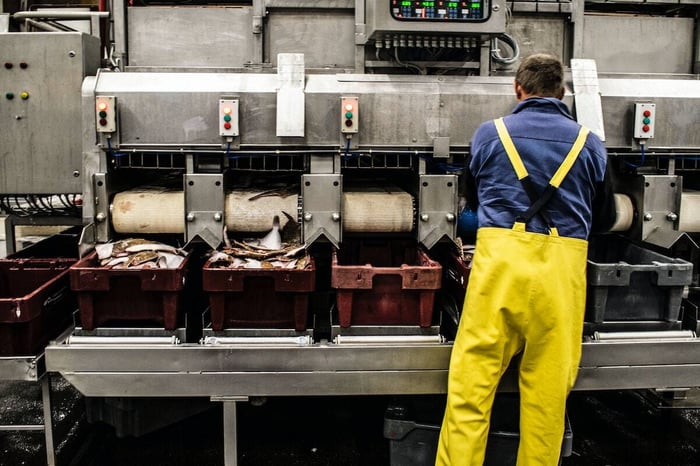
Access and structure are key when talking about the "sorting" aspect of 5S Standard Operating Procedures.
2. Set in Order
Next, order.
Organizing the items you need and putting them in the optimal place minimizes wasted time searching for tools or materials. This allows teams to quickly locate what they need, leading to smoother operations and faster task completion.
Focus on the "Golden Zone": For maximum efficiency, place the most frequently used tools and materials within the "Golden Zone"—the area between the user's shoulders and waist. This ergonomic placement reduces reaching and bending, which not only speeds up the process but also minimizes physical strain and fatigue.
The location and visibility of 5S standard operating procedures is crucial when "setting in order".
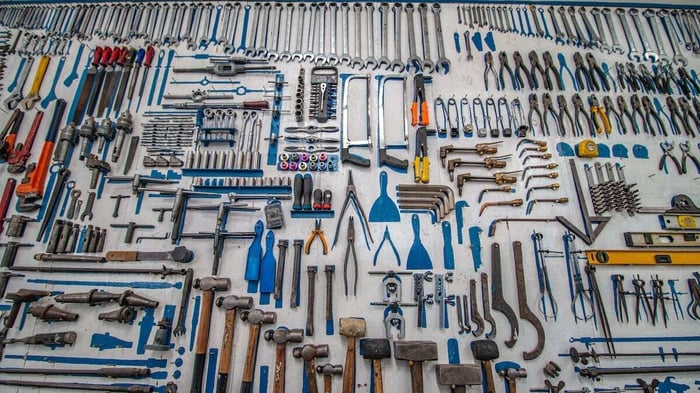
The location and visibility of 5S standard operating procedures is crucial when "setting in order".
3. Shine
Once everything's sorted out and organized, you need to make sure your workplace is clean.
The importance of cleanliness cannot be understated, especially if you’re dealing with expensive equipment.
Maintaining tidiness with regular cleaning and inspection enables employees to notice equipment malfunctions or misalignments quickly and avoid contamination or quality breaches.
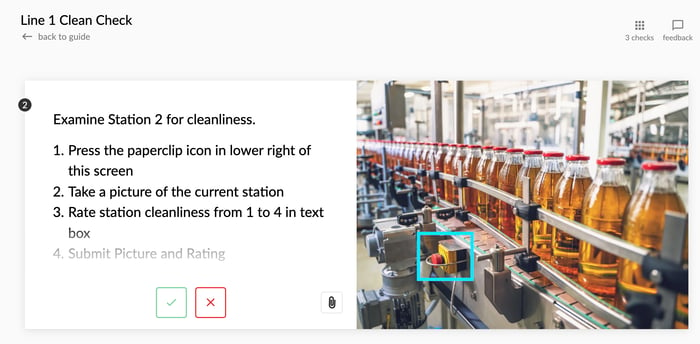
Checklists provide practical guidance of cleaning inspections in the "shine" aspect of 5S SOPs.
4. Standardize
To boost continuous improvement and innovation within your organization, making it tidy isn’t enough. You need to provide a consistent and clear plan that employees can follow.
Standardization ensures uniformity and reliability in operations, reduces variability and errors, and facilitates training and onboarding for new employees.
Read more about standardization in these articles:
- Standard Operating Procedures (SOP) Best Practices & Guidelines.
- Standard Operating Procedures: 5 Reasons Why You Need Them.
- What is a Standard Operating Procedure?
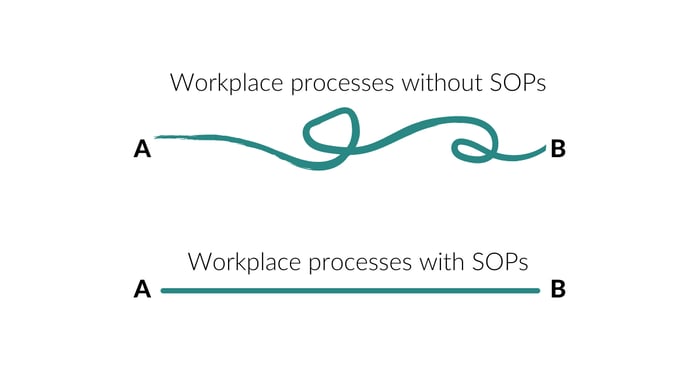 Standardization is the base for consistency and continuous improvement in 5S operating procedures.
5. Sustain
Last but not least, you need to make 5S a habit. The "Sustain" phase is often the most challenging because it requires a shift in workplace culture. To move beyond a one-time cleanup, organizations must move from top-down enforcement to peer-to-peer accountability.
- 5S Audits & Peer Reviews: Implement a rotating audit schedule where teams review each other's workstations. This fosters a sense of shared responsibility and healthy competition.
- Visual Management: Use 5S "Scoreboards" in common areas. When performance is visible, it becomes a point of pride rather than a chore.
- Gemba Walks: Leadership should regularly walk the floor not to "catch" mistakes, but to recognize consistency and remove roadblocks that prevent teams from staying organized.
Simple step-by-step instructions and digital tools make it easier for employees to embrace these best practices. For example, using a tablet with digitized procedures instead of long and dusty manuals ensures that the "standard" is always current and accessible.
Why 5s programs fail: Avoiding the Common Pitfalls
Despite its simplicity, many 5S initiatives lose momentum within the first six months. Drawing from cross-industry implementations, here are the primary reasons these programs stall:
- Treating 5S as a "Spring Cleaning" Event: The biggest mistake is viewing 5S as a one-time project rather than a continuous operational standard. When the "event" ends and the "real work" begins, the workplace quickly reverts to chaos.
- Lack of Leadership "Gemba" Presence: If management doesn't participate in "Gemba Walks" (on-the-floor observations) or prioritize 5S during busy production cycles, employees quickly learn that organization is optional, not fundamental.
- Ignoring the "Sustain" Infrastructure: Most companies nail the first three S's but fail to build the audit loops and peer-accountability systems required for the fifth. Without a formal feedback loop, there is no "standard" to fall back on.
- Over-Complicating the Documentation: If an employee has to flip through a 40-page binder to find a cleaning checklist, they won't do it. 5S SOPs must be visual, digital, and accessible at the point of use to survive the daily grind.
Frequently asked questions about 5S SOP's
What is the most difficult stage of 5S to implement?
The most difficult stage is Sustain, as it requires a permanent shift in organizational culture and individual habits. While the first four stages are tactical and visible, sustaining the gains requires long-term peer-to-peer accountability and leadership commitment to ensure the workplace doesn't gradually revert to its original state of disorder.
Can 5S be used in non-manufacturing environments?
Yes, 5S is highly effective in healthcare, retail, and digital office environments. In these settings, the "Sort" and "Set in Order" phases focus on reducing "digital friction" (cluttered servers or confusing filing systems) and optimizing the flow of information, which significantly reduces the time employees spend searching for critical documents or tools.
How often should a 5S audit be conducted?
In the early stages of a program, audits should be conducted weekly to reinforce new standards and catch deviations immediately. Once the culture matures, organizations typically move to monthly audits supplemented by daily, high-level visual checks by team leads to ensure the "Standardize" phase remains intact.
What is "6S" and how does it differ from 5S?
"6S" is the traditional 5S methodology with the addition of Safety as the sixth pillar. While safety is often considered an inherent byproduct of a clean 5S environment, 6S explicitly integrates risk assessment and ergonomic checks into every step, ensuring that organizational changes never compromise worker well-being.
How do digital SOPs improve 5S compliance?
Digital SOPs improve compliance by providing real-time accessibility and visual clarity at the point of work. Unlike paper manuals that collect dust, digital procedures can include "before and after" photos and interactive checklists that make it impossible for employees to misunderstand the required standard, leading to more accurate and frequent 5S execution.
What is the difference between a 5S Checklist and a 5S SOP?
While often used interchangeably, they serve different roles. A 5S SOP is the high-level instructional document that defines the "Gold Standard"—it explains the how and why of a process, including images of what a perfect workstation looks like. A 5S Checksheet is the tactical tool used during an audit to verify compliance with that SOP. Think of the SOP as the "textbook" and the Checksheet as the "test." Without the SOP, the checksheet is subjective; without the checksheet, the SOP is rarely followed. Both are essential for a lean management system.
Learn more about 5S and SOPs:
👉 Standard Operating Procedures (SOP) Best Practices & Guidelines.
👉 Standard Work = Processes + Procedures + Work Instructions.
👉 Empowering a Culture of Operational Excellence
Author

Gloria
Gloria is an expert storyteller with a keen eye for technical processes and years of experience in the tech industry. She creates content about how top manufacturers are digitizing their processes and embracing the developments of Industry 4.0. Read the rest of her articles to discover how innovative work instruction software can improve your processes.
Read author profile
-1.png)