

7 minutes read
Industry 5.0 is poised to revolutionize manufacturing by leveraging tech to support the human elements of our operations. LEARN MORE →
What is Industry 5.0?
Bridging the Gap Between Tech and Talent
Industry 5.0 is the next evolution of manufacturing, defined by a shift from pure automation to purposeful human-machine collaboration. While the previous industrial movement focused heavily on the "Smart Factory" through IoT and big data, Industry 5.0 puts people back at the center of the value chain. It envisions a future where human creativity and problem-solving are enhanced—not replaced—by advanced technologies like AI and collaborative robotics.
This shift is now a business imperative. By 2030, the U.S. manufacturing sector faces a projected $8.5 trillion loss due to talent shortages and the widening skills gap. Currently, a massive disconnect exists: 77% of workers are ready to learn new skills, yet only 34% feel supported by their organization’s development opportunities. Industry 5.0 closes this gap by fostering a growth mentality, training specialists to thrive in a future where digitalization meets sustainable, circular business models.
The Differences Between Industry 4.0 and Industry 5.0. What is Industry 5.0?
The primary distinction between these two eras lies in the "human element." Industry 4.0 was essentially about the machine; its goal was to create seamless, interconnected systems where computers could communicate and execute tasks with minimal human intervention. While manufacturers still rely on these 4.0 innovations—like advanced data analytics and automation—to drive success at scale, the focus was often on efficiency at the expense of the worker.
Industry 5.0 acts as the necessary correction. Research from McKinsey & Company has noted that Industry 4.0 often failed to deliver the expected economy-wide productivity growth because it sidelined human intuition. Industry 5.0 takes the digital infrastructure of 4.0 and adds a layer of human-centricity. While 4.0 asked, "How can machines do this faster?" Industry 5.0 asks, "How can machines help our people do this better?" Ultimately it puts humans back at the center of production and envisions a future where human creativity and problem-solving abilities are enhanced by advanced technologies.
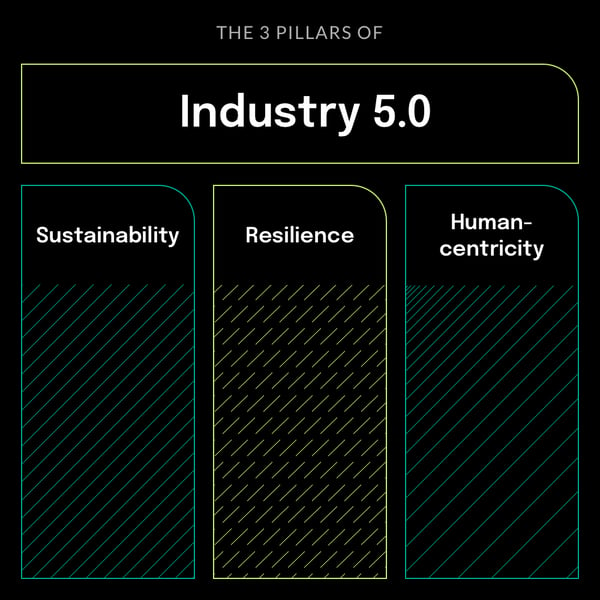
The three pillars of Industry 5.0.
Industry 5.0 focuses on cultivating three following elements:
Human-Centricity.
Industry 5.0 prioritizes humans as the focal point of innovation, aiming to enhance collaboration between humans and machines. Rather than replacing humans, technologies like augmented reality (AR) and wearable devices empower workers with real-time insights, boosting productivity and creativity. This shift fosters a workplace where technology complements human skills, enabling decision-making and reducing repetitive tasks.
- Improves job satisfaction by automating mundane tasks.
- Enhances worker productivity and creativity through real-time data.
- Creates a collaborative environment where human intuition complements machine efficiency.
Sustainability.
The emphasis in Industry 5.0 is on sustainable practices, leveraging technologies to minimize environmental impacts. It incorporates strategies like the circular economy - focusing on waste reduction, energy efficiency, and eco-friendly processes.
- Reduces emissions and energy consumption.
- Promotes the use of recycled materials and sustainable resources.
- Aligns industrial growth with global climate and environmental goals.
Resilience.
Industry 5.0 designs systems to adapt to and recover from disruptions, making businesses more robust in the face of challenges like supply chain shocks or global crises. This involves advanced data analytics, scenario planning, and distributed systems.
- Enhances the ability to withstand and adapt to unexpected events.
- Builds stronger, more agile supply chains.
- Ensures long-term business continuity and operational stability.
Key technologies that enable Industry 5.0.
While Industry 4.0 was built on the backbone of the cloud and the Internet of Things (IoT), Industry 5.0 introduces a more specialized toolkit designed to facilitate human-machine synergy and environmental stewardship. These technologies aren't just about speed; they are about extending human capability.
Collaborative Robots (Cobots): Unlike traditional industrial robots that operate behind safety cages, cobots are designed with advanced sensors to work safely alongside humans. By offloading repetitive or physically straining tasks to a cobot, human workers can focus on high-level assembly and quality control, creating a safer and more creative workspace.
Mass Personalization through AI: One of the most significant shifts in Industry 5.0 is the move away from mass production toward "Mass Personalization." Advanced AI algorithms now allow for "Lot Size 1" production—the ability to create highly customized, bespoke products at the same speed and cost as traditional mass manufacturing. This allows companies to meet modern consumer demands without sacrificing efficiency.
Digital Twins for Risk-Testing: To build the resilience mentioned in our pillars, manufacturers are increasingly relying on Digital Twins. These are virtual replicas of physical systems that allow teams to run "what-if" scenarios in a digital environment. By simulating supply chain shocks or equipment failures before they happen, companies can develop robust contingency plans without risking actual production downtime.
Bio-inspired Tech and Smart Materials: Finally, Industry 5.0 looks to nature to solve modern manufacturing challenges. Bio-inspired technology involves using synthetic, "smart" materials that can sense changes in their environment or even self-heal. These innovations are central to sustainability efforts, as they promote the use of biodegradable components and significantly reduce industrial waste through more efficient, nature-mimicking designs.
How to transition to Industry 5.0. A Strategic Roadmap
The transition to Industry 5.0 isn't about tearing down your current digital infrastructure; it’s about evolving how you use it. If you’ve already invested in Industry 4.0 technologies like IoT and data analytics, you are already halfway there. However, moving to the next level requires a deliberate shift in strategy.
Here are the practical steps to move your operations from pure automation to human-centric synergy:
Conduct a "Human-Machine" Audit.Start by evaluating your current automated processes. Are your digital tools making your employees' jobs easier, or are they creating bottlenecks and frustration?
- Action: Identify one high-stress or repetitive manual task where a collaborative robot (cobot) or AI assistant could take the physical or mental load off a human worker.
Close Support Gap with Upskilling.
Adopt energy-efficient machinery, explore renewable energy sources, and incorporate recycling strategies to promote sustainability. As we noted earlier, 77% of workers are ready to retrain, but many don't feel supported. Transitioning to 5.0 requires a formal commitment to "lifelong learning."
- Action: Create a structured upskilling roadmap. Instead of generic training, focus on "augmented roles"—teaching staff how to manage the AI and robotics that will be working alongside them.
Pilot "Augmented" Workflows.
Don't overhaul the entire factory at once. Start with a pilot project that emphasizes Human-Centricity.
- Action: Implement a digital twin or an AR-guided assembly line in one department. Use this "test cell" to gather feedback directly from the operators on how the technology improves their decision-making and job satisfaction.
Transition from Linear to Circular.
Sustainability in Industry 5.0 isn't just a "nice to have"—it’s a core business metric. You need to move from a "take-make-waste" model to a circular one.
- Action: Audit your energy consumption and waste streams. Look for opportunities to integrate bio-inspired materials or energy-efficient machinery that reduces your environmental footprint while lowering long-term costs.
Build Resilience Through Data Transparency.
To survive global disruptions, your digital infrastructure must be scalable and transparent across all departments.
- Action: Move away from "data silos." Ensure that your floor-level data is accessible to leadership in real-time. This transparency allows for faster scenario planning and more agile responses when the supply chain shifts.
Frequently asked questions about Industry 5.0
Does Industry 5.0 threaten job security?
No; it actually redefines it. While Industry 4.0 aimed for "lights-out" automation, 5.0 recognizes that machines can’t replicate human intuition. By using collaborative robots (cobots) for repetitive or dangerous tasks, workers move into higher-value roles as "technology orchestrators." This shift makes the human worker the most indispensable part of the line, focusing on quality and complex problem-solving rather than just manual labor.
What does "Human-Centricity" look like in practice?
It means the technology adapts to the person, not the other way around. On a shop floor, this looks like using AR headsets to guide a technician through a complex repair or using wearable sensors to prevent physical strain. Instead of a worker struggling to keep pace with a rigid machine, the digital tools provide real-time support to make their job easier, safer, and more efficient.
How does Industry 5.0 help meet sustainability goals?
It moves manufacturing from a "take-make-waste" model to a circular economy. By using AI to optimize resources and digital twins to simulate product lifecycles, manufacturers can achieve near-zero waste. Because Industry 5.0 prioritizes resilience, it also encourages localized production, which significantly cuts carbon emissions from global shipping and aligns businesses with strict new environmental regulations.
Is Industry 5.0 just a buzzword?
It’s a strategic pivot. While Industry 4.0 provided the connectivity, it often failed to deliver the promised productivity gains because it ignored the "human element." Industry 5.0 is the necessary correction. It’s a practical framework designed to solve the $8.5 trillion talent gap and the rising demand for green manufacturing. It isn't just a new label; it’s the evolution required to keep the industry functional and attractive to a new generation of workers.
Does it replace Industry 4.0?
Not at all—it builds on it. Think of Industry 4.0 as the digital infrastructure (sensors, cloud, and data) and Industry 5.0 as the human-led strategy that makes that data useful. You can’t have the collaboration of 5.0 without the digital maturity of 4.0. It’s an "operating system" upgrade for your factory that uses your existing tech stack to drive better social and environmental outcomes.
Can small and medium enterprises (SMEs) afford Industry 5.0?
SMEs are often the best candidates for Industry 5.0 because they are more agile. You don’t need a multi-million dollar overhaul to start. 5.0 can begin with scalable, affordable tools like cobots or modular AI that work alongside your current team. Much of this shift is about culture and upskilling, which costs far less than the "all-or-nothing" automation of previous years and provides a faster return on investment through reduced turnover.
More industry content:
👉 Digital Kaizen SOPs to Standardize and Continuously Improve.
👉 Inspirational Kaizen Quotes to Motivate your Team.
👉 12 More Lean Manufacturing Quotes to Inspire you.